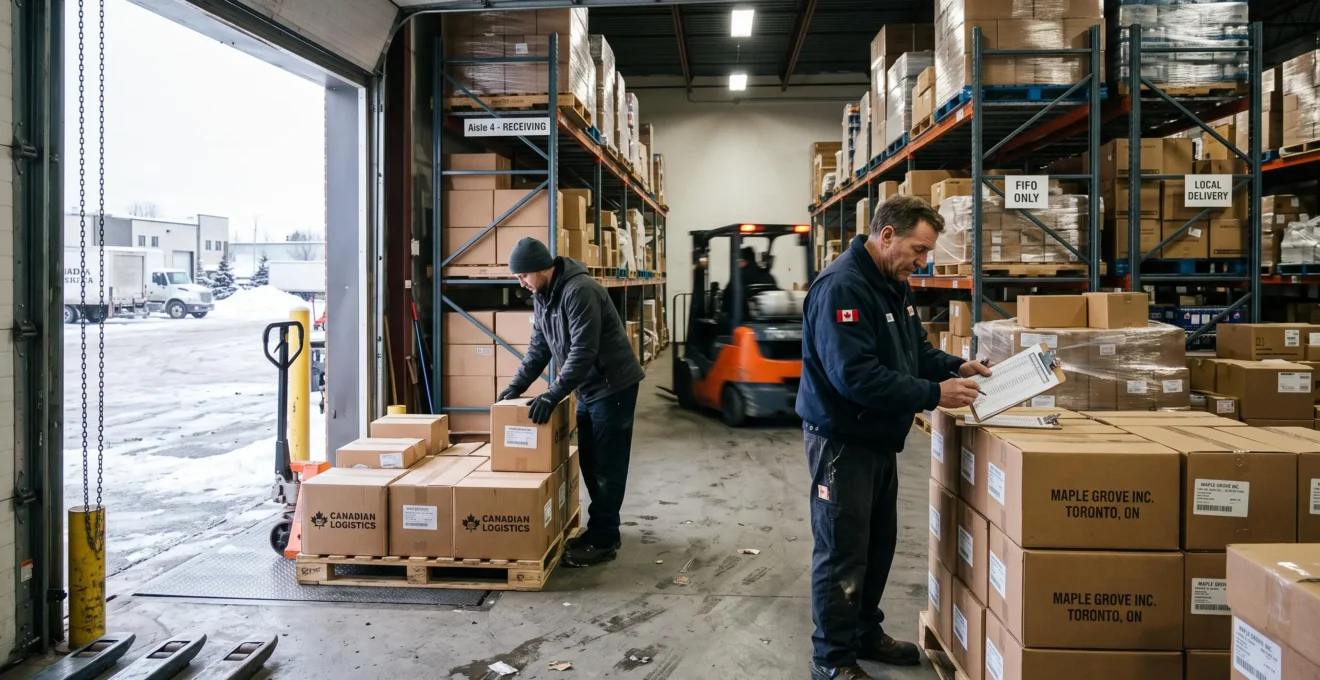
A Canadian retailer can have products on order and still face empty shelves. A manufacturer can have enough customer demand to keep its production line running, yet stop operations because one inexpensive component has not arrived. In both situations, buying more inventory may appear to be the safest response. It can also create a cash-flow problem without fixing the underlying supply risk.
Building a resilient small-business supply chain means reducing the likelihood and financial impact of disruptions while keeping inventory proportional to actual demand. That requires reliable delivery data, selective safety stock, qualified alternative suppliers and procurement decisions based on total cost rather than purchase price alone.
Canadian businesses face additional considerations when sourcing internationally: long transportation routes, exchange-rate exposure, customs requirements and changing trade conditions. These risks do not affect every product equally. A high-volume item with uncertain replenishment deserves different protection from a slow-moving product available locally within days.
The practical objective is to protect product availability without turning working capital into unnecessary warehouse stock.
Supply Chain Resilience: Key Decisions for Canadian SMEs
- Measure actual supplier lead times and demand variability before increasing inventory buffers.
- Prioritize backup suppliers and strategic stock for products that could interrupt sales or production.
- Compare total landed costs, delivery reliability and cash requirements before changing sourcing arrangements.
- Why Do International Shipping Delays Create Stock Shortages for Canadian SMEs?
- How to Set Safety Stock Levels When Supplier Delivery Times Are Unpredictable?
- Canadian or Overseas Suppliers: Which Offers Better Total Procurement Value?
- The Single-Supplier Vulnerability That Can Stop a Small Company’s Operations
- When Should a Canadian Business Replace an Unreliable Supplier?
- Hidden Cross-Border Costs That Can Turn an Export Sale Into a Loss
- How Supplier Quality Problems Multiply During High-Volume Manufacturing
- How Can Canadian Manufacturers Scale Production Without Sacrificing Quality or Cash Flow?
Why Do International Shipping Delays Create Stock Shortages for Canadian SMEs?
International shipping delays create shortages when replenishment takes longer than the inventory available to cover customer demand. Canadian SMEs are particularly exposed when they purchase smaller quantities, depend on distant suppliers or have limited storage and financing capacity. Even a temporary transportation disruption can exhaust available stock before replacement goods arrive.
The problem is not simply that international transportation takes time. It is that actual delivery dates can differ significantly from the dates used to plan purchasing.
Consider a hypothetical Canadian retailer importing products through Vancouver. Its inventory plan assumes that a shipment will arrive in six weeks, but an unexpected port delay extends delivery by another two weeks. If the business holds only six weeks of inventory and demand continues as expected, the additional delay can produce a stockout.
A larger retailer may have inventory distributed across several locations or alternative replenishment channels. A smaller business may have no comparable flexibility.
These interruptions can also contribute to the bullwhip effect. When retailers react to shortages by placing larger or more frequent orders, suppliers may interpret those orders as lasting demand growth. Production and replenishment decisions then become exaggerated throughout the supply chain. Once delayed shipments arrive together, the same business may face excess stock.
Two categories of delay require different responses:
- Recurring, relatively predictable delays: Seasonal port congestion, pre-holiday shipping pressure and supplier closures around major holidays can be incorporated into ordering calendars and lead-time assumptions.
- Unexpected disruptions: Labour disputes, transportation interruptions, canal blockages and customs holds require contingency options because their duration and timing cannot be reliably scheduled.
Ordering earlier can address expected seasonal delays, but it also commits cash sooner and increases exposure to inaccurate sales forecasts. A business expecting uncertain customer demand may be trading one risk for another.
A more useful starting point is to measure delivery performance. Export purchase-order records for the previous 12 months, where sufficient data exists, and record the order date, quoted delivery date and actual arrival date for each shipment. For inventory planning, also distinguish arrival at the port from receipt of usable stock at the warehouse.
Calculate the average actual lead time, the range of observed lead times and the difference between quoted and actual delivery performance. The average gap reveals systematic underestimation, while the spread of actual delivery times reveals uncertainty that an average alone conceals.
A twelve-month review is a practical starting window rather than a universal statistical requirement. Seasonal patterns, limited order histories and exceptional disruptions may justify additional analysis.
Once delivery uncertainty is measurable, the business can calculate targeted inventory protection instead of increasing stock indiscriminately.
How to Set Safety Stock Levels When Supplier Delivery Times Are Unpredictable?
Canadian SMEs should set safety stock by examining both customer-demand variability and actual supplier lead-time variability. The objective is to cover a realistic disruption scenario consistent with the product’s importance and the business’s service target, not automatically the longest imaginable delay. Inventory buffers should be larger only where the expected cost of a shortage justifies the additional investment.
Start by separating two sources of uncertainty. Demand safety stock protects against customers purchasing more units than forecast. Supply protection covers replenishment arriving later than expected. Both may need to be considered together because high demand during a delayed delivery creates a more severe shortage than either condition independently.
A simplified planning exercise can use three figures for each product: typical demand during replenishment, plausible high demand during replenishment and demand exposure under a longer but realistic lead time.
For example, imagine a hypothetical retailer selling approximately 20 units per week. A supplier normally takes four weeks to replenish, but a credible delayed-delivery scenario extends that period to six weeks. At the normal sales rate, those additional two weeks represent 40 units of potential demand. If demand also increases during the delay, the required protection could be higher.
This illustration is a planning stress test, not a statistically validated safety-stock calculation. A formal model may be preferable when the business has sufficient observations to estimate demand distributions, lead-time variability and service-level probabilities.
Not all products warrant the same protection. A practical classification should consider:
- Sales velocity and demand predictability.
- Gross margin and contribution to revenue.
- Customer consequences of an unavailable product.
- Replacement lead time and availability of substitutes.
- Storage, financing, obsolescence and other carrying costs.
The Business Development Bank of Canada recommends adapting inventory decisions to individual products rather than applying identical thresholds across an entire catalogue. Its guidance on BDC’s five steps to optimize inventory management highlights margins, carrying costs, replenishment times and stockout consequences as relevant inputs.
This approach helps prevent a common overreaction. Following an expensive stockout, managers may increase safety stock across every product category. Fast-moving critical items can benefit, but slow-moving products may accumulate without meaningfully improving customer service.
Set a review date when each buffer is approved. Quarterly reassessment is a useful management practice, particularly after transportation disruptions, but faster-moving businesses or changing market conditions may require more frequent revisions.
Each review should ask whether historical delays still represent current supplier performance, whether demand has changed and whether the cost of holding protection remains justified.
Inventory buffers are only one form of protection. Supplier location, transportation routes and the ability to replenish quickly can sometimes reduce the amount of stock a Canadian business needs to hold.
Canadian or Overseas Suppliers: Which Offers Better Total Procurement Value?
Neither Canadian nor overseas suppliers consistently offer the best procurement value. The stronger choice depends on total landed cost, demand stability, delivery reliability and the financial impact of a stockout. Overseas sourcing may provide attractive unit costs for predictable volumes, while Canadian suppliers can offer advantages when shorter replenishment times, smaller orders or operational flexibility outweigh price differences.
A purchase-price comparison misses costs that can materially change the outcome. Canadian buyers should account for:
- Freight, insurance arrangements and transportation-related surcharges.
- Applicable customs duties and brokerage expenses.
- Exchange-rate movements and currency conversion costs.
- Minimum order quantities and supplier payment requirements.
- Inventory financing while goods are produced or transported.
- Storage and additional safety stock needed for longer replenishment cycles.
- Lost contribution margin and other consequences of delivery failure.
These factors can make a higher-priced Canadian quotation commercially competitive. The reverse may also be true: a dependable overseas supplier with efficient shipping and sufficient order volume may still offer the lower total cost.
A hybrid sourcing strategy is worth evaluating when products have predictable baseline demand but occasional urgent replenishment needs. An overseas supplier could handle planned purchases while a Canadian or nearby qualified supplier provides limited surge capacity.
The domestic supplier’s higher unit price can then be assessed as the cost of maintaining flexibility. However, maintaining two suppliers creates qualification, administrative and commercial costs of its own. For low-volume SMEs, dual sourcing is not automatically economical.
The following decision grid summarizes the trade-offs.
| Decision criterion | Canadian supplier | Overseas supplier |
|---|---|---|
| Demand pattern | Often attractive for variable demand and frequent replenishment | Often attractive for stable, forecastable demand |
| Order quantity | Potential advantage when smaller batches are available | Potential advantage when larger volumes support favourable pricing |
| Transportation exposure | May reduce exposure to international shipping delays | May require longer planning horizons and contingency capacity |
| Inventory investment | Shorter replenishment can reduce required pipeline stock | Longer transit and larger orders can increase cash commitments |
| Commercial flexibility | Potentially easier coordination and smaller adjustments | May offer specialized capacity or manufacturing economies |
The relevant comparison is between actual supplier offers, not assumptions about where suppliers are located. Canadian sourcing may still involve imported inputs, and an overseas vendor may provide dependable local warehousing or shorter delivery commitments.
North American sourcing also requires attention to the Canada–United States–Mexico Agreement (CUSMA). Qualifying goods may receive preferential tariff treatment, but supplier location alone does not establish eligibility. Product-specific origin rules and the applicable documentation must be satisfied.
The Canada Border Services Agency explains the documentation requirements in its CUSMA certification of origin requirements. Certification can be completed by an eligible importer, exporter or producer, subject to the required information and supporting records.
Businesses must also verify applicable tariff classifications, current duties and any additional trade measures for their specific goods.
Once the sourcing structure is understood, the next question is whether any single supplier remains capable of shutting down operations altogether.
The Single-Supplier Vulnerability That Can Stop a Small Company’s Operations
Single-supplier dependence becomes a serious operational risk when the loss of one supplier can interrupt a critical product, essential component or major source of revenue before an alternative is available. A Canadian SME may appear diversified across many vendors while remaining dependent on one manufacturer for an irreplaceable part. Identifying that dependency is more important than simply counting suppliers.
A practical supplier concentration audit should assess both commercial exposure and operational substitutability.
Start by identifying products or production lines dependent on each vendor. Estimate the proportion of revenue associated with those products, but do not treat revenue share as the sole risk indicator. An inexpensive component representing a small purchasing expense may still be essential to completing a finished product.
Next, estimate how long operations could continue if the supplier stopped shipping immediately. Compare usable stock and substitute availability with the time required to qualify and receive another source.
Flag suppliers whose failure would stop important operations within one replenishment cycle, particularly where no approved replacement exists. This is an internal risk-screening rule, not a universally established concentration threshold.
Full dual sourcing is not always feasible. A small manufacturer may lack enough annual demand to secure favourable prices or priority from two vendors.
More realistic alternatives include qualifying a backup supplier for occasional orders, holding a carefully sized strategic buffer for a genuinely irreplaceable component, or changing product specifications to permit an approved substitute.
The BDC’s article on supply chain resilience and diversification recommends assessing alternative suppliers before disruptions, testing samples, starting with smaller orders and expanding purchases after checking consistency. It also discusses redesigning products as a potential response to sourcing limitations.
Supplier relationship management is another protection mechanism. Sharing realistic demand forecasts, communicating production changes early and paying according to agreed terms can help suppliers plan capacity. Such practices may improve collaboration, although they do not guarantee priority allocation during shortages.
Watch for changes in supplier performance and behaviour. Repeated shipment postponements, unexpected staff turnover, declining communication quality or requests to accelerate payments can warrant closer investigation. None independently proves financial distress, but a combination may justify activating contingency plans.
Five Actions to Audit Critical Supplier Dependencies
- Map critical products to their suppliers and produce a supplier-to-product dependency register.
- Calculate revenue associated with each supplier-dependent product line and record the exposure in a concentration worksheet.
- Estimate remaining operating time without each critical supplier and document the result in a disruption-impact matrix.
- Identify at least one possible substitute, backup supplier or product redesign option for every high-priority dependency and create a qualification-status register.
- Assign a supplier-review owner and record performance changes, warning signals and contingency triggers in a monthly monitoring log.
The audit is complete only when management knows which dependencies deserve action, what each contingency would cost and how quickly it could realistically be activated.
Monitoring also helps distinguish temporary supplier difficulties from persistent unreliability, making eventual replacement decisions more evidence-based.
When Should a Canadian Business Replace an Unreliable Supplier?
A Canadian business should consider replacing a supplier when repeated delivery or quality failures create costs greater than the expected cost and risk of switching, particularly when corrective actions have not worked. The decision should reflect measurable service performance, financial consequences and the availability of a qualified alternative rather than an isolated frustrating shipment.
A useful starting metric is on-time-in-full performance, or OTIF. It measures the proportion of orders delivered by the agreed date in the agreed quantity. Businesses should define consistently whether the metric is calculated by order, shipment or order line, and whether delivery means arrival at the warehouse or availability for use.
Track performance over a rolling review period. Then connect service failures to the financial consequences they create, including emergency freight, production downtime, cancelled customer orders, extra inventory and administrative recovery work.
Suppose a hypothetical supplier has a lower unit price but repeatedly requires emergency deliveries. Those extra charges, combined with the inventory needed to compensate for uncertain arrival dates, may erase its apparent price advantage.
The reverse is also possible. A supplier with an occasional failure but reliable communication and a credible corrective-action plan may be less risky than an unfamiliar alternative.
Signs that corrective action may be appropriate include:
- Failures are isolated or linked to a clearly identified temporary event.
- The supplier shares accurate information about delays or quality problems.
- A documented recovery plan includes responsibilities and verifiable milestones.
- Subsequent shipments demonstrate improving performance.
Replacement becomes more compelling when failures are persistent, communication is opaque, promised corrective actions repeatedly fail or the supplier cannot demonstrate adequate capacity and process control.
However, switching during a crisis introduces its own risks. An untested vendor may offer attractive delivery promises without having proven production capability, consistent quality or dependable transportation arrangements.
Begin the search while the existing supplier is still active. Obtain samples, verify specifications, place a limited trial order where commercially feasible and monitor actual performance before transferring major purchasing volumes.
The exit plan also needs contractual and operational review. Check minimum purchase commitments, outstanding orders, inventory already in production, ownership of tooling or moulds, proprietary specifications and arrangements for recovering essential technical information.
Depending on the contracts and circumstances, legal advice may be appropriate before terminating supply commitments or transferring intellectual property and production assets.
Supplier reliability becomes particularly important when procurement crosses borders, where delivery failures can combine with customs, contractual and currency costs.
Hidden Cross-Border Costs That Can Turn an Export Sale Into a Loss
An export transaction can become unprofitable when the final cost of fulfilling the order exceeds the margin built into the selling price. Canadian SMEs should assess transportation, customs, currency and delivery obligations before issuing a quotation, not after shipment. The quoted selling price must reflect the costs the seller is contractually responsible for bearing.
Cross-border costs are often fragmented across carriers, customs brokers, banks and logistics providers. As a result, the sales team may calculate profitability using the factory cost and a basic freight estimate while overlooking expenses that arise later.
A practical export costing worksheet should include the following categories.
| Cost category | Potential expense | Verification method |
|---|---|---|
| Transportation | Freight, fuel surcharges and last-mile delivery | Carrier quotation covering the required route and services |
| Customs | Brokerage, applicable duties, taxes and documentation | Broker review of classification, origin and shipment terms |
| Port and terminal | Handling, demurrage and detention where applicable | Carrier and terminal terms, including free-time provisions |
| Currency | Exchange-rate movements and conversion spreads | Currency exposure worksheet and bank or FX-provider quotation |
| Delivery exceptions | Storage, redelivery, correction fees and possible returns | Shipment-specific contingency assessment |
These costs should be allocated according to the sales contract. A business should not add every possible customs and shipping charge automatically to the seller’s expense, because contractual delivery terms determine which party is responsible for particular obligations.
That is why Incoterms are a commercial pricing decision, not merely an administrative detail.
Under Ex Works (EXW), the seller generally makes the goods available at the agreed location, while the buyer takes substantial responsibility for transportation and customs arrangements. Under Delivered Duty Paid (DDP), the seller assumes much broader transportation, delivery and applicable customs-clearance obligations.
The International Chamber of Commerce Academy explains these differences in its comparison of EXW and DDP Incoterms. The ICC also notes practical difficulties when a foreign seller cannot readily complete import procedures in the destination country. Other terms, including FCA and DAP, may sometimes be more appropriate.
Canadian exporters should specify the chosen Incoterms 2020 rule and named place clearly, while checking insurance arrangements and other contractual obligations separately.
Currency exposure deserves its own calculation. A company quoting in US dollars while purchasing inputs in Canadian dollars or another currency may see its expected margin change before payment is received.
For confirmed orders, a bank or foreign-exchange specialist may offer a forward contract that fixes an exchange rate for an agreed transaction. Such arrangements have contractual conditions and potential costs, so they should match actual commercial exposure rather than speculative currency expectations.
For Canada–US shipments, product classification, customs processes, origin documentation and applicable trade measures all require verification. A CUSMA certification may support preferential treatment for eligible goods, but does not eliminate all border requirements or guarantee duty-free entry in every circumstance.
Exporters should coordinate with their customs broker and US importer or customer to confirm responsibilities and documentation before dispatch. Canadian export reporting requirements, where applicable, also need separate attention.
Even a correctly priced and documented shipment can generate substantial losses if products fail quality requirements, particularly when manufacturing volumes increase.
How Supplier Quality Problems Multiply During High-Volume Manufacturing
Supplier quality problems become more expensive as production volumes increase because even a modest defect rate can affect many more units. Larger batches can amplify material waste, inspection work, rework, delivery delays and customer returns. Canadian manufacturers should strengthen quality verification before expanding orders rather than assume that successful small production runs guarantee consistent mass production.
Consider a hypothetical component supplier with a 2% defect rate. At 100 units, that rate corresponds to two defective components. At 10,000 units, the same rate corresponds to 200. The calculation illustrates the impact of volume; it is not an industry defect-rate benchmark.
The financial impact can extend beyond replacing defective components. A failed part may require disassembly, additional labour, production rescheduling or the rejection of completed goods.
A factory that performed well during small orders may also lack the systems needed for large-scale consistency. Informal visual checks, experienced workers and direct owner supervision can be effective at limited volumes but may not scale to multiple production shifts.
Before increasing purchasing commitments, assess whether the supplier has documented work instructions, incoming-material controls, calibration practices, change management and consistent defect-recording procedures.
A tiered inspection process can match quality controls to production exposure:
- Conduct a first-article inspection to confirm that initial production output meets approved specifications before broader manufacturing proceeds.
- Introduce in-process checks at defined production stages, especially where defects would be expensive or difficult to correct later.
- Carry out pre-shipment inspection using documented acceptance criteria and, where appropriate, a sampling plan suitable for the product and its risk level.
Sampling does not guarantee defect-free shipments. Critical safety, regulatory or functional requirements may require more stringent testing or additional controls determined by the product and applicable standards.
Inspection responsibilities also need to be agreed upon with the supplier. Specifications should define measurable requirements, permitted tolerances, traceability expectations and procedures for reporting nonconforming goods.
When a defect appears, the manufacturer needs to know which batches are affected and whether production can continue using verified inventory. Without traceability, a limited quality issue can force broader quarantine and worsen shortages.
Quality management therefore supports resilience directly. A rejected international shipment does not merely increase production costs; it can create a replenishment gap just as damaging as a transportation interruption.
At higher volumes, the value of preventing repeated defects can grow substantially. Nevertheless, inspection effort should be proportional to failure consequences, production risk and the effectiveness of existing process controls rather than increasing mechanically with every order.
Maintaining this discipline is especially important when a manufacturer expands production, because growth increases the cash committed to raw materials, work in progress and supplier relationships.
Key Takeaways Before Expanding Production
- Confirm that demand and contribution margins can support additional production capacity before committing to equipment or larger material orders.
- Finance essential inventory protection and supplier diversification deliberately, rather than relying on future sales to cover immediate cash requirements.
- Expand supplier qualification, inspection capacity and production controls alongside output so growth does not create new operational bottlenecks.
How Can Canadian Manufacturers Scale Production Without Sacrificing Quality or Cash Flow?
Canadian manufacturers can scale production more safely by expanding capacity in stages, validating demand before major commitments and maintaining quality controls at each production level. Growth should be financed against realistic cash-flow requirements, including raw materials, labour, equipment and inventory in transit. Increasing output without matching operational controls can turn additional sales into shortages, rework and liquidity pressure.
Scaling creates a timing problem. A manufacturer may need to buy more materials, hire employees, secure equipment and finance longer production cycles well before customers pay for finished goods.
The expansion may therefore increase revenue while reducing available cash in the short term. If the business also holds strategic safety stock or maintains secondary suppliers, those resilience measures require financing too.
A practical scaling sequence begins with confirmed demand signals. Purchase orders, customer contracts and credible recurring demand are stronger foundations than optimistic sales projections alone, although none eliminates commercial risk.
Next, calculate the incremental working capital required for each production stage. Include supplier deposits, raw materials, work in progress, payroll, finished goods, transportation and expected customer payment timing.
Capacity can then be expanded in manageable increments rather than through a single irreversible commitment. Depending on the business, options might include an additional shift, selective equipment investment, qualified subcontracting or a limited increase in production-line capacity.
Each stage should have measurable approval conditions:
- Actual order demand supports the planned output.
- Expected contribution margins remain positive after incremental production and logistics costs.
- Cash forecasts account for procurement and customer payment timing.
- Suppliers can meet increased volume and quality requirements.
- Inspection capacity and trained staffing are sufficient for the next production level.
Canadian manufacturers can also investigate financing options suited to growth and working capital requirements. The Business Development Bank of Canada offers business financing and advisory services, while federal and regional development organizations may provide programs relevant to particular investments or business profiles.
Eligibility, financing terms and program availability depend on the applicant, project, location and current program conditions. Financing should not be assumed available until the business has reviewed the requirements and received appropriate confirmation.
The most dangerous growth bottleneck can emerge where quality control and cash flow intersect.
For example, a hypothetical manufacturer may add production capacity before new employees are fully trained or before a new material supplier has passed qualification. Higher production output initially looks promising, but defective batches require rework, customers delay acceptance and the manufacturer must pay additional labour and material costs before collecting revenue.
In this situation, production growth has created a new cash-flow problem rather than strengthening the business.
Manufacturers can reduce this risk by approving additional capacity only when the corresponding quality processes, supplier capabilities and cash reserves are demonstrably ready. Short production trials, documented inspection results and updated cash forecasts can support those decisions.
Operational resilience should also be reflected in regular management reporting. Useful measures include supplier delivery reliability, inventory availability, production defect trends, cash tied up in stock and the cost of emergency procurement.
These indicators allow management to identify whether higher production volume is actually improving business performance or simply increasing operating exposure.
A practical next step is to review the company’s highest-risk products, confirm the availability of qualified suppliers and prepare a staged cash-flow forecast for the next capacity increase. This creates a measurable starting point for strengthening the supply chain without accumulating inventory that the business cannot profitably use.
Can a small Canadian business improve supply chain resilience without buying more stock?
Yes. Improving supplier delivery visibility, correcting inaccurate lead-time assumptions, qualifying substitutes and strengthening supplier communication can reduce disruption exposure without a general increase in inventory. Some critical products may still justify strategic buffers, but protection should be selective and financially justified.
Which supply chain risks should a small manufacturer prioritize first?
Prioritize risks that could stop important production or customer deliveries and cannot be resolved quickly. These often include irreplaceable single-source components, consistently unreliable lead times and critical quality failures. Rank them by operational impact, recovery time, available alternatives and financial exposure rather than purchase value alone.
Does buying from a Canadian supplier eliminate international supply chain risk?
No. A Canadian supplier may depend on imported raw materials, overseas components or international transportation. Domestic purchasing can reduce some delivery and coordination risks, but buyers should investigate upstream dependencies, production capacity and contingency arrangements before assuming the supply chain is entirely domestic.
What information should be included in a basic supplier risk dashboard?
A practical dashboard can track quoted versus actual lead times, on-time-in-full performance, quality issues, critical inventory coverage, supplier concentration and the status of qualified alternatives. It should also identify owners and actions for significant exceptions. A well-maintained spreadsheet may be adequate for a small operation before more advanced software is needed.
How can a business determine whether supply chain resilience measures are worth their cost?
Compare the cost of each measure, such as backup supplier qualification or additional buffer inventory, with the plausible financial impact and likelihood of the disruption it addresses. Include carrying costs, lost contribution margins, production downtime and recovery expenses. Because severe disruptions are uncertain, scenario analysis and management judgement are often necessary alongside historical data.